English
By Products
Welding Machine
By Application
Automation Production Line

Search
Manufacturing the stainless steel ring used around a glass pot lid involves much more than simply joining two ends of a metal strip. Cutting accuracy, ring forming, welding quality, crimping, stretching, chamfering, and final forming all influence whether the ring fits the glass lid correctly and maintains a consistent appearance.
When these operations are handled by separate machines and operators, material transfer and manual positioning can become major sources of variation. An automated pot cover production line connects the main processes into a coordinated manufacturing sequence, helping manufacturers reduce manual handling while maintaining more consistent production.
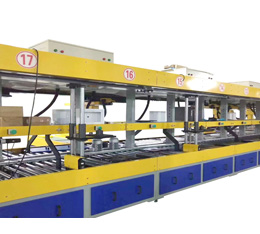
XIHE's automatic stainless steel belt production line for pot covers is designed for the welding and forming of stainless steel strips used in glass pot lid G-rings. The system integrates multiple operations and is specified for diameters of 120–390 mm, strip thickness below 0.7 mm, widths of 16–45 mm, and a production speed above 650 pieces per hour.
Production starts with stainless steel strip prepared according to the required width and thickness.
The strip must first be cut to the correct length for the target ring diameter. Accurate feeding and cutting are important because even a small length deviation can affect the diameter after the strip is formed into a circle.
The basic production sequence can include:
feeding and cutting → rounding → welding → crimping → stretching/forming → chamfering or angle pressing → unloading
XIHE's pot cover production-line platform combines laser cutting, rounding, continuous welding, crimping, stretching, chamfering and unloading into an automated process.
Each stage affects the next one. Poor cutting accuracy makes welding alignment more difficult, while an inconsistent weld joint can affect later forming. This is why integrating the processes can provide more value than simply making one individual machine faster.
The joint is one of the most important areas of a stainless steel lid ring.
Both strip ends need to meet accurately before welding. Excessive gap, overlap, or misalignment can create an uneven seam that becomes more visible after subsequent forming.
For this type of application, welding should provide enough joint strength for later crimping and stretching while minimizing unnecessary deformation.
XIHE's automatic line uses continuous laser welding technology as part of its G-ring production process. The manufacturer describes the system as automatically clamping, processing, and unloading the workpiece once material has been loaded.
The practical production goal is not simply to obtain a welded joint. Manufacturers should evaluate whether the seam remains stable throughout the subsequent forming operations and whether its appearance meets the finished cookware requirement.
Different welding methods can join thin stainless steel strip, but the requirements of pot lid manufacturing make heat input, weld appearance, cycle time, and automation compatibility particularly important.
Laser welding concentrates energy into a relatively small area. For thin stainless steel rings, this can help produce a narrow weld while limiting the amount of surrounding material affected by heat.
It is also well suited to automated positioning because parameters can be programmed and repeated once the product and tooling have been validated.
Traditional welding processes can still be appropriate for certain products, but additional finishing or more manual handling may be required depending on the welding method and appearance specification.
For a high-output line, the relevant comparison should therefore include:
cycle time;
weld consistency;
post-weld finishing;
thermal deformation;
automation compatibility;
changeover requirements;
cost per finished ring.
The best process is the one that supports the complete production sequence rather than producing a good-looking seam in isolation.
After welding, the circular strip still needs to be transformed into the profile required for the glass lid.
Crimping forms the edges or profile of the stainless steel ring. Stretching and subsequent forming operations bring the ring closer to its final geometry, while chamfering or angle pressing can create additional features required by the lid design.
These operations must remain dimensionally coordinated.
If the ring diameter changes too much during one forming step, later tooling may not position the workpiece correctly. Similarly, inconsistent welding can cause local deformation when the ring is stretched.
XIHE's system automates the transfer through these forming processes and uses replaceable molds for different product specifications. The manufacturer states that changing the mold allows the line to process different product types.
For buyers, mold design and changeover should therefore be discussed alongside machine speed. A production line needs to match the actual product range, not just one sample diameter.
A traditional process may use individual machines for cutting, welding, crimping, stretching, and forming. Workers then load, unload, inspect, and transfer rings between stations.
This approach can remain practical at low volumes, but labor involvement increases as output grows.
According to XIHE, the processes incorporated into its automatic line previously required approximately five to six workers, whereas the integrated line can be operated with one person mainly responsible for material loading.
The potential benefits are broader than labor reduction.
Automated transfer can reduce:
repeated workpiece positioning;
queues between separate machines;
handling damage;
differences caused by individual operators;
work-in-process inventory.
However, full automation is most attractive when product volume and repeatability justify the equipment investment.
A manufacturer producing small quantities of many unusual ring designs may prioritize flexibility. A factory producing established pot lid sizes continuously may benefit more from an integrated line.
Maximum machine speed is only one part of real production capacity.
XIHE specifies a forming speed above 650 pieces per hour for its automatic stainless steel belt pot cover line under its stated configuration. It supports product diameters from 120 to 390 mm, thickness below 0.7 mm, and strip widths from 16 to 45 mm.
Actual output can also depend on:
ring diameter;
material thickness;
strip width;
welding parameters;
forming complexity;
mold design;
product change frequency;
material feeding;
inspection requirements.
Before purchasing a line, buyers should therefore provide representative drawings and product specifications rather than requesting a quotation based only on “pot lid production.”
A useful RFQ should include target diameters, stainless steel grade, strip thickness and width, ring profile drawings, required hourly output, electrical standard, available factory space, and expected product-change frequency.
These details help determine whether an existing line configuration can be used or whether tooling and automation need to be customized.
XIHE's line is primarily designed for stainless steel strips used in glass pot lid G-rings, combining welding and multiple forming operations.
Yes, within the machine's supported range, but tooling or molds may need to be changed according to the product specification.
The listed product diameter range is 120–390 mm, with stainless steel strip thickness below 0.7 mm and width from 16 to 45 mm.
It can be, particularly when the product family shares similar production steps. Buyers should evaluate mold-change time and the frequency of model changes before deciding how much automation is appropriate.
Provide drawings, ring diameter, strip material, thickness, width, profile requirements, expected capacity, product range, factory power supply, and available installation space.